Friday, October 30, 2015

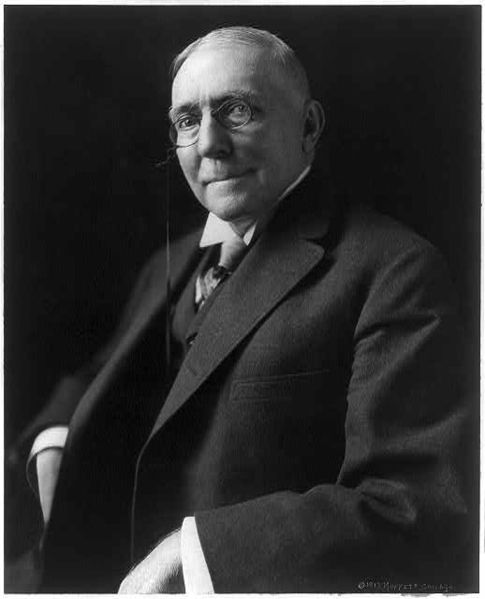
James Whitcomb Riley, Folksy Hoosier Poet, Dead of Stroke at 66


If James Whitcomb Riley, sometimes called the “Hoosier Poet” and sometimes the “Children’s Poet,” is remembered at all today, it is for a handful of humorous dialect verses that include “Little Orphant Annie,” “The Raggedy Man,” and “When the Frost is on the Punkin’.” But in his heyday in the 1880s and 1890s, he was widely read and immensely wealthy from both his verse and his popular public readings—which were so successful that Mark Twain, with whom Riley often shared the stage, refused to continue their joint appearances since he felt he was always upstaged. Despite his stardom, Riley was frequently so drunk he couldn’t perform.

This odd literary figure was born October 7, 1849, in Greenfield, Indiana, the son of a successful lawyer and his wife.  He began his working days as a sign painter, submitting bits of verse to newspapers on the side. Eventually he obtained a permanent job with the Indiana Journal, for which he wrote a society column studded with his verses. He also submitted his poetic output to Henry Wadsworth Longfellow, the nation’s most revered poet in the 1860s and 1870s, hoping for an endorsement. A few months before Longfellow’s death, Riley managed to barge his way into Longfellow’s home, even though doctors had ordered the ailing elder poet to receive no visitors.  Shortly after he died, Riley published embellished accounts of his visit and the praise that Longfellow had lavished upon him.  It wasn’t long until Riley was able to inherit the mantle of the nation’s leading poet.

Never married and fighting alcoholism all his life, Riley had a twelve-year on-and-off romance with a Greenfield schoolteacher named Clara Bottsford. Eventually his drinking caused them to split.

Riley took a boyish delight in playing pointless practical jokes. He would pretend to be blind and draw a crowd to watch him paint a sign. He once rigged up a long hose from an abandoned cellar to the adjacent building and projected his voice through the hose, calling out to passersby that he was trapped in the cellar. His most infamous prank backfired on him.  He persuaded the editor of the Kokomo Dispatch to publish a poem he had written in the style of Edgar Allan Poe, claiming it was a newly discovered unpublished piece of Poe’s work. It was picked up by a few other newspapers, but the sensational hoax Riley had hoped for did not materialize. The trouble was, the poem didn’t fool many people, and most critics said it wasn’t good enough to have been written by Poe.

Riley was reared a Methodist and maintained an affiliation with that church. His religious belief and his views of personal immortality conform to conventional Christian theology. In a poem called “The Evangelist,” he wrote:

            The Motive? That all tongues confess
            To Him—our Hope and Righteousness!
            Tho’ now the view be darkly dim,—
            Through faith we’ll win the world to Him!

            And Victory?  It will be won!
            God’s Promise—through His Promised Son!
            We’ll sing it in the realms above—
            Enraptured by Enraptured Love!

And in a poem entitled “We Must Believe,” he wrote:

                        O there must be
            Some fair, green, flowery pathway endlessly
            Winding through lands Elysian! Lord, receive
            And lead each as Thine Own Child--even the Chief
            Of us who didst Immortal life achieve....
            Lord, I believe:
            Help Thou mine unbelief.

By 1895 Riley was so successful he was earning $1,000 a week from his book sales and nationwide public readings—the equivalent of about $30,000 today. He received honorary degrees from Yale, Penn, and Indiana universities, and the National Institute of Arts and Letters awarded him a special medal for poetry.

But his persistent alcoholism caught up with him, and in 1901 he was diagnosed with a nervous disorder that his doctors called neurasthenia. It caused him constant fatigue, headaches, irritability, and emotional distress. He remained ill for the final fifteen years of his life. In 1909 he had an attack of Bell’s palsy, refusing to take any medicines except patent potions (which he used to peddle in his youth) and, of course, frequent doses of whiskey. In 1910 he had a stroke that paralyzed his right side, but after three years he was able to walk unsteadily with a cane.

On July 22, 1916, Riley suffered another stroke; he seemed to recover during that day and was able to joke with friends. But during that night he died in his sleep, at the age of sixty-six.

The governor of Indiana ordered that Riley’s body lie in state at the capitol building on Monday, July 24, from 3:00 until 6:00 p.m.—an honor that had been previously accorded by the state to only one person, Abraham Lincoln. More than 35,000 people filed past the open coffin, and thousands more were turned away. 

The following day at 2:30 p.m., with only family and close friends present, a funeral service at the Riley home on Lockerbie Street in Indianapolis was conducted by the Reverend Joseph A. Milburn, former pastor of the Second Presbyterian Church in Indianapolis and a good friend of Riley’s. Riley’s body was loaded into a white hearse and taken to Crown Hill Cemetery, where he was interred in a flower-bedecked Gothic crypt with Turkish carpets on its floor. Riley’s hometown of Greenfield waged an ardent campaign to have his body moved to the family cemetery there, but Riley’s survivors decided that he would remain at Crown Hill permanently.

Note: Photo copyright by Moffatt, 1913

Friday, October 23, 2015

‘Thanatopsis’ poet William Cullen Bryant dead at 83 from head injuries in a fall


William Cullen Bryant had a long and distinguished career as an editor, orator, and poet, but he is now remembered mostly for only two poems: “To A Waterfowl” and his eloquent meditation on death, “Thanatopsis.” 

Born November 3, 1794, in a log cabin near Cummington, Massachusetts, to a doctor and his wife, both of whom traced their ancestries to the Mayflower,  William developed an interest in poetry at an early age.  He published poems when he was thirteen and was working on “Thanatopsis” by the time he was seventeen. He attended Williams College for one year, where he complained in a satirical verse the “pale-faced, moping students crawl / Like spectral monuments of woe.” He hoped to transfer to Yale, but family finances necessitated his apprenticeship at a law firm instead. He was admitted to the bar in 1815 and began a lackluster legal career, which lasted until 1825, when desire for the literary life impelled a move to New York City with his wife and daughter.

Bryant was fortunate to have connections, and he quickly landed the job of editor of the New-York Review, a literary journal. Then he became the assistant to the editor of the New-York Evening Post, a daily newspaper that had been founded by Alexander Hamilton. An unexpected turn of events just two years later—the editor fell ill owing to a stroke brought on by a duel—elevated Bryant to editor-in-chief of the paper, a post he held for the next half century.  He became a noted liberal voice in support of Andrew Jackson, organized labor, immigrants, minorities, tighter banking regulation, prison reform, and the abolition of slavery—and in opposition to the annexation of Texas.

He also became a widely respected poet, much of his work influenced by a group known as the “Graveyard Poets,” who included Thomas Gray, Oliver Goldsmith, and William Cowper, noted for their gloomy emphasis on mortality. This interest in death, along with Bryant’s Unitarian religious views, developed in his youth when he broke from the Calvinist teachings of the Congregational church in which he was raised, are reflected in “Thanatopsis.” In it, he writes:
                            When thoughts   
                Of the last bitter hour come like a blight   
                Over thy spirit, and sad images   
                Of the stern agony, and shroud, and pall,   
                And breathless darkness, and the narrow house,   
                Make thee to shudder, and grow sick at heart;—   
                Go forth, under the open sky, and list   
                To Nature’s teachings, while from all around—
                Earth and her waters, and the depths of air—
                Comes a still voice—
                             Yet a few days, and thee   
                The all-beholding sun shall see no more   
                In all his course; nor yet in the cold ground,   
                Where thy pale form was laid, with many tears,   
                Nor in the embrace of ocean, shall exist   
                Thy image. Earth, that nourished thee, shall claim   
                Thy growth, to be resolved to earth again,
                And, lost each human trace, surrendering up   
                Thine individual being, shalt thou go   
                To mix for ever with the elements,   
                To be a brother to the insensible rock   
                And to the sluggish clod, which the rude swain   
                Turns with his share, and treads upon.
            …
                            All that breathe   
                Will share thy destiny. The gay will laugh
                When thou art gone, the solemn brood of care   
                Plod on, and each one as before will chase   
                His favorite phantom; yet all these shall leave   
                Their mirth and their employments, and shall come
                And make their bed with thee.
                …
                                 So live, that when thy summons comes to join   
                The innumerable caravan, which moves   
                To that mysterious realm, where each shall take   
                His chamber in the silent halls of death,   
                Thou go not, like the quarry-slave at night,   
                Scourged to his dungeon, but, sustained and soothed   
                By an unfaltering trust, approach thy grave,   
                Like one who wraps the drapery of his couch   
                About him, and lies down to pleasant dreams.

Of his own departure from life, Bryant said, “If I am worthy, I
would wish for sudden death, with no interregnum between I
cease to exercise reason and I cease to exist.” But he expected
to be around for quite a long time. Just days before his death at
the age of eighty-three, he told a friend that he planned to live into his nineties. When asked on what he based that belief, he replied, “It is all summed up in one word—moderation. As you know, I am a moderate eater and drinker, and moderate in my work, as well as in my pleasures, and I believe the best way to preserve the physical and mental faculties is to keep them employed. Don’t allow them to rust.”

Alas, all that moderation came to naught. On the afternoon of Wednesday, May 29, 1878, Bryant delivered an address at the dedication of a bust of the Italian patriot Giuseppe Mazzini in New York’s Central Park. Bryant’s friend James Grant Wilson described his appearance on the podium: “a majestic man with his snow-white hair and flowing beard, his small, keen but gentle blue eyes, his light but firm lithe figure standing so erect and apparently with undiminished vigor, enunciating with such distinctness.” But Wilson went on to say that Bryant hesitated frequently during his speech and lost his place in his notes on several occasions.

Following the ceremony Wilson and his little daughter accompanied Bryant as they walked to Wilson’s home nearby. Wilson later recalled, “As we approached my house, about four o’clock, Mr. Bryant was… cheerfully conversing…as we walked up arm in arm, and all entered the vestibule. Disengaging my arm, I took a step in advance to open the inner door, and during those few seconds, without the slightest warning of any kind, the venerable poet, while my back was turned, dropped my daughter’s hand and fell suddenly backward through the open outer door, striking his head on the steps. I turned just in time to see the silvered head striking the stone, and, springing to his side, hastily raised him up. He was unconscious, and I supposed that he was dead.”

Ice water was applied to his head and Bryant was carried inside and laid on a sofa, still unconscious. In a few minutes he sat up, and drank a goblet of iced sherry, then said, “Where am I?  I do not feel at all well.  Oh, my head, my poor head.” After a while, Wilson accompanied Bryant to his own house, leaving him in the care of his niece, and then went to summon Bryant’s personal physician, Dr. John Gray.

Dr. Gray recounted: “I sent for Dr. Carnochan, the surgeon. He could find no injury to the skull, and therefore thought there was a chance of recovery. Mr. Bryant, during the first few days, would get up and walk about the library or sit in his favorite chair. He would occasionally say something about diet and air. When his daughter arrived from Atlantic City, where she had been for her health, she thought her father recognized her.  It is uncertain how far he recognized her or any of his friends.

“On the eighth day after the fall, hemorrhage took place in the brain, resulting in paralysis, technically called hemiplegia, and extending down the right side of the body. After this he was most of the time comatose. He was unable to speak and when he attempted to swallow, food lodged in his larynx and choked him. He was greatly troubled with phlegm, and could not clear his throat. There was only that one attack of hemorrhage of the brain, and that was due to what is called traumatic inflammation.”

Bryant died on June 12, two weeks after his fall, at the age of eighty-three. It is possible that an undiagnosed stroke caused his fall and the subsequent brain damage resulting in his death. 

A memorial service was held on June 14 at All Souls’ (Unitarian) Church on Fourth Avenue (now Park Avenue South) at 20th Street. He was buried in Roslyn Cemetery in Nassau County, Long Island, where he had a summer home. Bryant Park, adjacent to the New York Public Library, was named in his honor in 1884.

Friday, October 16, 2015

Tainted cole slaw contributed to the death of ‘worsifier’ Ogden Nash at 68


Everyone who knows that candy is dandy can undoubtedly provide the next line of that short verse by Ogden Nash. The undisputed American master of light verse was born August 19, 1902, in Rye, New York, a descendant of Francis Nash, the Revolutionary War general for whom Nashville, Tennessee, was named. Nash attended private school in Rhode Island, and then entered Harvard University, where he stayed for only a year.

He went to work as a Wall Street bond salesman (later claiming he sold only one bond in two years—to his godmother) and then taught school, wrote copy for the same New York advertising agency that had once employed F. Scott Fitzgerald, worked in the marketing department at Doubleday publishers, and finally joined the editorial staff of The New Yorker—a job that lasted only three months. After his first book, Hard Lines, won national acclaim, Nash gave up day jobs and devoted himself fulltime to humorous verse, in which he often satirized American social life. With his wife, Frances, he moved to Baltimore, where he lived the rest of his life. 

Known both for his trenchant observations as well as his whimsical rhyming—such as “sybarites” with “flibbertigibberites” and “paunchy” with “Givenchy”—Nash created nonsense verse that conveyed plenty of common sense. Never assuming the mantle of poet or even of versifier, instead he called himself a “worsifier.” Among his output were fourteen books of light verse, several Hollywood screenplays (among them bits of The Wizard of Oz), the book and lyrics for the 1943 Broadway musical One Touch of Venus (which included the hit song “Speak Low, When You Speak Love”), several children’s books, the Broadway revue Nash At Nine, and frequent lectures and television appearances. 

Nash could be insouciant about religious observance and the afterlife, as he indicates in a verse called “I Didn’t Go to Church Today”:

                        I didn't go to church today,
                        I trust the Lord to understand.
                        The surf was swirling blue and white,
                        The children swirling on the sand.
                        He knows, He knows how brief my stay,
                        How brief this spell of summer weather,
                        He knows when I am said and done
                        We'll have plenty of time together.

Nash’s stay was all too brief and ended on May 19, 1971, at the age of sixty-eight, in Baltimore’s Johns Hopkins Hospital, where he succumbed to Crohn’s disease, an inflammatory bowel disorder, complicated by a lactobacillus infection acquired from consuming cole slaw that had been improperly handled. As Nash might possibly have observed, if he hadn’t died before he could think of it:

            The sole flaw
            Of cole slaw:
            A bacillus
            That can kill us.

Nash is buried in East Side Cemetery in North Hampton, New Hampshire, a seaside town where he spent the summers.

 “I Didn’t Go to Church Today,” by Ogden Nash, from The Best of Ogden Nash, Ivan R. Dee, Chicago, 2007. ©2007 by Linell Nash Smith and the estate of Isabel Nash Eberstadt. Reprinted with permission.

Friday, October 9, 2015

Asthma-Plagued Marcel Proust, 51, Dead of Pneumonia and Lung Abscess


For the last three years of his life, asthma-plagued Marcel Proust rarely left his bedroom, at 44 rue Hamelin in Paris, as he worked feverishly in his bed, strewn with notebooks and papers, hoping to finish his masterpiece, À la recherche du temps perdu. Undoubtedly he missed his cork-lined room, where he was sequestered from the noise and the dust of the outside world, at 102 boulevard Haussman, his home for many years until 1919, when his widowed aunt sold that property, forcing him to move. Medications for his worsening asthma, allergies, and bronchitis consisted of an enormous array of nostrums— stramonium (jimson weed) cigarettes, fumigations of carbolic acid, various therapeutic powders, heavy doses of caffeine, epinephrine, opium, morphine, and Veronal. 

On one of the few occasions that he ventured from his room, he attended an opening night dinner party at the Hotel Majestic for the premiere of Igor Stravinsky’s ballet Renard. Other guests included Nijinsky, Diaghilev, Pablo Picasso, and James Joyce. Proust wound up sharing a taxi with Joyce, but the two exchanged hardly a word, since neither had read anything written by the other.

Sickly from childhood, Marcel was born in Auteuil, a suburb of Paris on July 10, 1871, to a Catholic father, who was a distinguished pathologist, and literary-minded Jewish mother, who came from a wealthy family. Marcel was baptized and confirmed as a Roman Catholic, but never practiced that religion—nor did he ever consider himself Jewish.  One biographer described his religious views in later life as those of a “mystical atheist,” spiritual but not believing in a personal God.

He suffered his first asthma attack at the age of nine, and at eleven was enrolled in the Lycée Condorcet, although his education was frequently interrupted by bouts of illness. Even so, he excelled in his studies and gained access to some of Paris’ prestigious literary salons. His father worried that Marcel was too effeminate, and when he was sixteen, gave him ten francs to visit a brothel and “become a man.”  Marcel’s experience was not a happy one, as he wrote in this letter to his grandfather:

“My dear little grandfather,
I appeal to your kindness for the sum of 13 francs…Here is why. I needed so badly to see if a woman could stop my bad habit of masturbation that Papa gave me 10 francs to go to a bordello. First, I was so agitated that I broke a chamber pot: 3 francs; then, still agitated, I was not able to screw. So here I am, waiting desperately as the hours pass for 10 francs to help myself, plus 3 francs for the pot. But I dare not ask Papa for more money so soon and so I hoped you could come to my aid in a situation which, as you know, is not just exceptional but unique. It surely cannot happen twice in a lifetime that a person is too flustered to screw.”

Proust never acknowledged that he was, in fact, homosexual. When he was seventeen he attempted to cultivate an affair with a woman who was his uncle’s mistress—and, as Marcel later learned, also his father’s.  He also had homosexual affairs with Jacques Bizet, the composer Georges Bizet’s son; Lucien Daudet, the writer Alphonse Daudet’s son; and the composer Reynaldo Hahn.

From its inception in 1909 until his death, Proust worked on his chef d’oeuvre, which was to consist of seven novel-length volumes. The first, Du côté de chez Swann, was rejected by numerous publishers (including André Gide), and Proust finally paid for its printing and distribution himself.  It met with considerable success with the public and other volumes followed.  The last three were published posthumously.

In one famous passage the hero experiences an epiphany of memory triggered by the taste of a madeleine biscuit dipped in tea. This was based on a real-life event in 1909, when Proust experienced the revival of a childhood memory set off by a biscuit—except that in reality the biscuit was a rusk, more like Melba toast or zwieback than a delicately sweet, almond-flavored madeleine.

By the early fall of 1922, Proust’s asthma worsened, his breathing became more labored, and he could hardly take any nourishment.  Yet he continued to work on Le Temps retrouvé, the last volume of À la recherche du temps perdu.  He knew he was near death, and in it he wrote:

"Undoubtedly my books, like my earthly being, will finally die. One must resign oneself to the notion of death and accept the idea that in ten years one's self, and in a hundred years one's books, will no longer exist. Eternal life is not promised to books any more than to men.”

The asthma developed into pneumonia and an abscess of the lung. His devoted attendant, Celeste Albaret, the wife of his chauffeur, attended to his needs, trying to coax him into eating an occasional croissant to keep up his strength. Proust’s brother, Robert, who was a prominent physician, remained with him during his last days and oversaw attempts to make him comfortable. Robert recommended that he have an injection to relieve his breathing, but Marcel refused.  Instead he insisted on sending Celeste out for beer, which was supposed to be a bronchodilator. At 6:00 the evening of November 18, 1922, Proust died in the bedroom where he had done most of his writing. He was fifty-one.

A funeral mass was celebrated in the chapel of Saint Pierre de Chaillot in Avenue Marceau, and with his parents and other family members, Proust was buried in Père Lachaise cemetery.

Friday, October 2, 2015

‘Prairie Troubador’ Poet Vachel Lindsay ended his life at 51 with a bottle of Lysol


Honored during his lifetime as the “Prairie Troubador,” and for a brief time one of America’s best-known poets, Vachel Lindsay had so little financial success that he was forced to wander the countryside, trading his poems for food and lodging, and was finally so discouraged that he ended his life by drinking a bottle of Lysol.

Born November 10, 1879, in Springfield, Illinois, to a physician and his wife, who were devout Campbellites, Vachel was reared as a member of the non-denominational sect founded in 1830 and dedicated to the restoration of early Christianity. After a sketchy education culminating at the Campbellite Hiram College in Ohio, where he failed to take a degree, Lindsay began to paint, draw, and write poetry. He worked in various jobs: as a clerk in the toy department of Marshall Field’s department store in Chicago; as a guide at the Metropolitan Museum of Art in New York; as a laborer in the Nicholls Gas Tubing Works in New York; as a lecturer on racial relations, motion pictures, morality, and other topics, for the Springfield YMCA, the Anti-Saloon League, Columbia University and the University of Chicago; and as a journalist in Spokane, Washington. At one point in life, he wandered like a vagabond around the country, from Florida to New Mexico, hawking his poems on the streets or bartering them door-to-door for food and lodging.

His notable poems include “Abraham Lincoln Walks at Midnight,” “General Willliam Booth Enters Into Heaven,” “The Kallyope Yell,” and his most famous—“The Congo: A Study of the Negro Race,” which often finds its way into school anthologies. Although his poems never sold well enough to support him, they brought him much fame, and he was the first American Poet invited to lecture at Oxford University, in 1920.

Lindsay remained influenced by his Campbellite upbringing throughout his life. He had visions of Christ and the Old Testament prophets, and he wrote many mystical poems laying out his view of heaven, hell, and the moral universe.

Lindsay was a friend of the poet Sara Teasdale, whom he asked to marry him. She turned him down and instead chose a rich shoe manufacturer for her husband. Lindsay moved to Spokane, where he met Elizabeth Conner, a schoolteacher whom he married in 1925. They eventually settled with their two children in Lindsay’s childhood home in Springfield.

Constantly on tour, lecturing and reading poems, in an effort to scrape together enough money to support them, Lindsay became discouraged at his lack of success. After years of this hand-to-mouth existence, his health suffered, and he fell into a deep depression. He had been earlier diagnosed with epilepsy and he also suffered from paranoid delusions, resulting in public outbursts of rage and threats of violence to his family.

On the night of December 5, 1931, his wife heard him get out of bed around midnight.  She followed him downstairs and found him arranging family pictures. She asked if he was all right, and he replied, “Yes, dear, I’m quite all right. I’ll be up in a moment.” Mrs. Lindsay returned to bed and fell asleep. About fifteen minutes later, she heard a crash, jumped up, and discovered Lindsay crawling up the stairs on his hands and knees. His face was ashen. When he reached the top of the stairs, he got up and ran down the corridor, waving his hands in the air. Mrs. Lindsay screamed, and Lindsay collapsed. She put him to bed, and he asked for water, saying, “I took Lysol.”

A doctor was summoned, but Lindsay was already dying, in the room above the room where he had been born. His last words were, “They tried to get me, but I got them first.” When the doctor arrived, he pronounced Lindsay dead of “heart failure.” He was fifty-one.

Downstairs, Mrs. Lindsay found her picture and those of their children propped up on a table with two candles burning. In the bathroom was a glass with remnants of Lysol in it and a large empty Lysol bottle. Lysol is the trade name of a disinfectant that was introduced in 1889.  It may contain a variety of ingredients that are toxic when swallowed. In 1911 Lysol was the most common means of suicide in Australia, according to newspaper reports.

Lindsay's funeral at Springfield’s First Christian Church was attended by hundreds of mourners, and he was laid to rest in Oak Ridge Cemetery, not far from the grave of Abraham Lincoln. On his tombstone are carved his name and one word: “Poet.”

Friday, September 25, 2015

‘Enfant Terrible’ Poet Arthur Rimbaud Dead of Bone Cancer at 37


There has never been an enfant more terrible than Arthur Rimbaud. An accomplished poet while still in primary school, he began a torrid love affair at seventeen with poet Paul Verlaine, ten years his senior. He moved in with Verlaine and his wife and was a houseguest from hell: his room was a squalid sty, he indulged heavily in absinthe and hashish, he sunbathed stark naked in the front garden, he picked lice from his overgrown hair and flicked them onto visitors, he smashed china, he desecrated an heirloom crucifix, he sold some of his hosts’ furniture, and he used a magazine containing poems by a friend of Verlaine’s for toilet paper. Verlaine, enamored of the boy, was delighted with his antics.

Throughout these rambunctious teen years Rimbaud created a body of poems, including Le Bateau ivre, Une Saison en Enfer, and Illuminations,  that became hallmarks of French surrealism.  But he stopped writing before he was twenty-one, and never turned out another line of verse.

Rimbaud was born October 20, 1854, in Charleville in the Ardennes region of northern France. His father was an infantry officer frequently away from home, and Arthur’s parents separated when he was six, leaving him to be raised by his rigid, narrow-minded, humorless, miserly mother, whom he called the “mouth of darkness.” A priest at the Pension Rossat, where Arthur was enrolled, inspired him to love Greek, Latin, and French literature, and encouraged him to write poetry. Arthur’s first verse was published when he was fifteen.

By the time he was seventeen, Rimbaud had become a dyed-in-the-wood rebel: he consumed alcohol, wrote obscene poems, stole books, and allowed his appearance to grow unkempt and disheveled. Rimbaud made his connection with Verlaine by sending him letters and samples of his own poetry. Verlaine replied with a one-way train ticket to Paris and a letter that read, “Come, dear great soul.  We await you. We desire you.”

Desire him, Verlaine did. They had a stormy and scandalous affair—the twenty-seven-year-old, newly married established literary figure, with the seventeen-year-old country lad. They indulged in absinthe and hashish, and reveled in their sexual excesses, even collaborating on a “Sonnet du trou du cul”—which can most politely be translated as “Sonnet in Praise of the Butthole,” and whose contents are decidedly pornographic. Rimbaud entered into a prolific period of creativity during the next three years, turning out virtually his entire body of work in that time.

In 1872 Verlaine abandoned his wife and child and took Rimbaud with him to England, where they lived in Bloomsbury and Camden Town, and scraped a living by teaching and an allowance from Verlaine’s mother. Rimbaud stuck to his writing in the Reading Room of the British Museum to take advantage of the free heating, lighting, pens, and ink. After several months in London, Verlaine went to Brussels, where he asked his mother and Rimbaud to join him at the Hotel Liège.  Now drinking even more heavily, Verlaine bought a pistol, with which he intended to commit suicide, but instead he used it to shoot Rimbaud in the wrist during a violent lovers’ quarrel. Rimbaud declined to press charges but wisely decided to hightail it out of Brussels. On the way to the train station, Verlaine threatened him again, and Rimbaud summoned a police officer and had him arrested. Verlaine served two years in prison for the assault.

Rimbaud returned home to Charleville and wrote his last verses, after which he abandoned poetry forever. In 1875 he and Verlaine met for the last time. Verlaine had become an exceedingly pious Catholic, and Rimbaud described him as “clutching a rosary in his claws.” They parted on chilly terms.

In 1876 Rimbaud went to Vienna, where he was robbed of all his money and stripped of his clothes by a cab driver. The French consul general arranged for his passage back to France. Then he joined the Dutch Colonial Army and served in the East Indies, but deserted into the Indonesian jungle and eventually found his way back to France once more. He went to Cyprus as a stone quarry foreman, from there to Yemen,  and then to Harar, Ethiopia, as a coffee merchant, gun runner, and slave trader.

Back in Paris, the name of Rimbaud was becoming well-known from the works that had been published earlier.  In Africa, his personality could hardly have been more different from the wild days of his youth. People who knew him said he was taciturn, withdrawn, gruff, and unsociable, but honest and methodical as a trader, with a dry sense of humor. He led a simple, almost ascetic, life, and he delighted in helping the poor.

In February of 1891, when he was thirty-six, he noticed a pain in his right knee, which made it difficult to walk, and he assumed it was arthritis. When it became more troublesome, he had a canvas stretcher made and was carried on it more than 150 miles across the desert to the port of Zeila in Somaliland. From there, he sailed to Aden, Yemen, where he saw a European doctor, who misdiagnosed his ailment as tubercular synovitis, an inflammation of the membrane around the kneejoints, frequently seen in rheumatoid arthritis.  He recommended immediate amputation of the leg.

Rimbaud remained in Aden until May 7, when he took the steamer L’Amazone on a thirteen-day voyage to Marseille, where he was admitted to Conception Hospital, and on May 27 underwent amputation of his leg.  It was discovered that he was actually suffering from osteosarcoma, advanced bone cancer, and had only a few months to live. He wrote to his sister Isabelle: “What a nuisance, what a bore, what misery when I think of my former travels, and how active I was just 5 months ago! Where is my skipping across mountains, the walks, the treks through deserts, across rivers, and over seas? And now, the life of a one-legged cripple…. And to think I had decided to come back to France this summer to get married! Goodbye to wedding, goodbye to family, goodbye to future! My life is gone, I'm no more than an immobile trunk.”

Isabelle joined him in Marseille and remained with him during his last days, engineering his deathbed conversion to the Catholic Church. She wrote to their mother in Charleville on October 28: “He is no longer a poor, unrepentant sinner.  He is now a saint, a martyr, one of the just, one of the chosen! Sunday morning, after mass, one of the priests came to see him and offered to hear his confession—and he accepted! As he left, the priest told me, ‘Your brother has the true faith. I have never seen faith of this quality.’ I kissed the ground with joy.  There is joy, even in his death, now that his soul is saved!”

Despite his repentance, the priest did not offer Rimbaud communion since he felt he was too weak to receive it and might vomit on the host.

Isabelle described her brother’s condition: “His stump is extremely swollen.  There is an enormous cancerous growth between his hip and his belly, just on top of the bone.  All the doctors—ten of them have visited him—seem terrified by this strange cancer. They say his case is unique, and there is something about it they don’t understand. Arthur’s head and left arm are in great pain, but he usually remains in a a deep lethargy, apparently sleeping.  At night he has a morphine injection.  When he wakes, he says odd things, thinking we are in Ethiopia or Yemen and must find camels and organize a caravan…He has the thinness of a skeleton and the color of a corpse. And his poor limbs are all paralyzed, mutilated, and dead around him.  O God, how pitiful!” 

Rimbaud died on November 10, 1891, at the age of thirty-seven.  He was buried at his place of birth in Charleville.

Friday, September 18, 2015

Rheumatic heart killed Scottish poet Robert Burns, 37, after tooth pulled


Voted “Greatest Scot of All Time,” poet Robert Burns won a 2009 ballot over “Braveheart” William Wallace, penicillin discoverer Alexander Fleming, “Dr. Who” star David Tennant, magnate Andrew Carnegie, and comedian Billy Connolly. Poor Sir Sean Connery, Bond credentials and all, didn’t make it into the top ten finalists.                     Painting by Alexander Nasmyth

What vaulted the Bard of Ayrshire to this pinnacle were poems and lyrics like Tam o’ Shanter, “My Luve Is Like A Red, Red Rose,” “Flow Gently, Sweet Afton,” the annually inevitable “Auld Lang Syne”—and hundreds of others that embody and preserve Scottish heritage. This tragic figure lived his entire life on the edge of poverty and died at age thirty-seven on the same day his wife gave birth to his fourteenth child.

Born in Alloway, Scotland, on January 25, 1759, he was the first of seven children of a tenant farmer who moved from farm to farm and never had much success. Robert was mostly home-schooled. His father died in bankruptcy in 1784, and he and his brother continued to work their farm, with back-breaking labor and little to show for it, except Robert’s contracting rheumatic fever, which brought about his premature death following the extraction of a tooth.

Something of a tomcat when it came to romance, Burns dallied with a number of local women and fathered his first child in 1785. One biographer said of him, “It was not so much that he was conspicuously sinful as that he sinned conspicuously.” In 1786 Burns married Jean Armour and took a low-paid position as an excise officer. He scrabbled all his life to support his rapidly expanding family, while devoting all his spare time to ballads, songs, poems, and letters to his friends. 

Raised as a liberal Calvinist who never really accepted the notion of predestination of the select, he confided his religious views in a letter to a friend:
“I am in perpetual warfare with that doctrine of our Reverend Priesthood, that 'we are born into this world bond slaves of iniquity and heirs of perdition; wholly inclined to that which is evil and wholly disinclined to that which is good until by a kind of Spiritual Filtration or rectifying process Called effectual Calling & etc.-' I believe in my conscience that the case is just quite contrary. We came into this world with a heart and disposition to do good for it, until by dashing a large mixture of base Alloy called Prudence alias Selfishness, the too precious Metal of the Soul is brought down to the blackguard Sterling of ordinary currency...”

Never very firm in his religious beliefs, Burns vacillated on the subject of an afterlife. “Jesus Christ,” he once wrote, “thou amiablest of characters, I trust thou art no Imposter, and that thy revelation of blissful scenes of existence beyond death and the grave, is not one of the many impositions which time after time have been palmed off on a credulous mankind.” One commentator called Burns “a wistful agnostic.”

Burns’ death on July 21, 1796, has been the subject of much speculation. His earliest biographer, Dr. James Currie, blamed it on excessive drinking and womanizing that led to venereal disease. Though there is no question Burns seldom said no to a “wee doch and dorris,” evidence indicates that his death was caused by bacterial endocarditis acquired with the extraction of a tooth and introduced into his bloodstream by a heart valve damaged by rheumatic fever.

As he lay ill, knowing that he was dying, his wit and sense of humor did not abandon him. When he looked up and saw his friend and physician, Dr. William Maxwell, at his bedside, he said,  "Alas! What has brought you here? I am but a poor crow and not worth plucking." Maxwell described Burns’ last moments: “When his attendant, James Maclure, held a cordial to his lips, he swallowed it eagerly - rose almost wholly up - spread out his hands - sprang forward nigh the whole length of the bed - fell on his face and expired.”

Burns’ funeral five days later was attended by a large crowd of mourners and he was laid to rest in St. Michael’s Churchyard in Dumfries. Through his twelve children who survived to adulthood, Burns now has more than 600 living descendants.